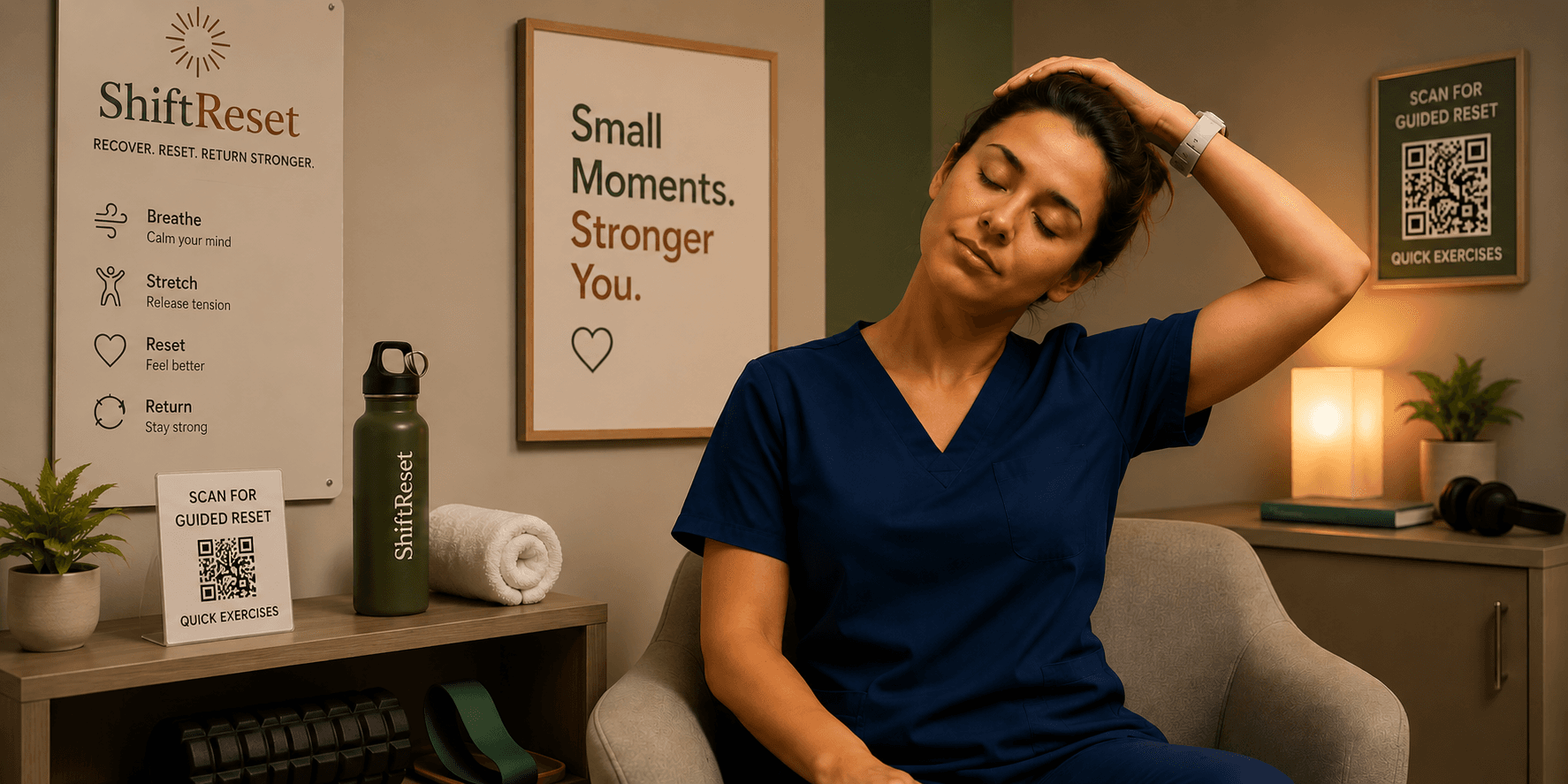
ShiftReset™
Recovery for the healthcare workplace that starts during your shift and continues after you clock out.
Recover in 2–5 minutes between patients, procedures, or difficult moments.
Built with healthcare workers and grounded in clinical research on stress recovery, breathing, movement, and nervous system regulation. No app download. Just scan the QR code. No dedicated room required. Just evidence-based recovery that fits into the workflow of a busy shift.
See ShiftReset in action.
Watch this quick 60 second overview to see how it supports recovery during and after a demanding shift.
Measure what matters in 30 days
Every ShiftReset pilot gives you a clear, human-centered view of how recovery lands on the unit. What staff experience Satisfaction, stress levels, and physical discomfort — before and after. How teams engage Utilization rates, favorite recovery tools, and average reset length. What it means for your unit Real feedback, actionable recommendations, and a clear signal of intent to continue. Baseline and post-pilot feedback come standard, so you can measure adoption, engagement, and perceived impact well before you scale.
Recovery for healthcare workers, built for the unit.
ShiftReset brings guided resets and pain relief tools directly to your floor. No app, no extra time, just real relief between codes.
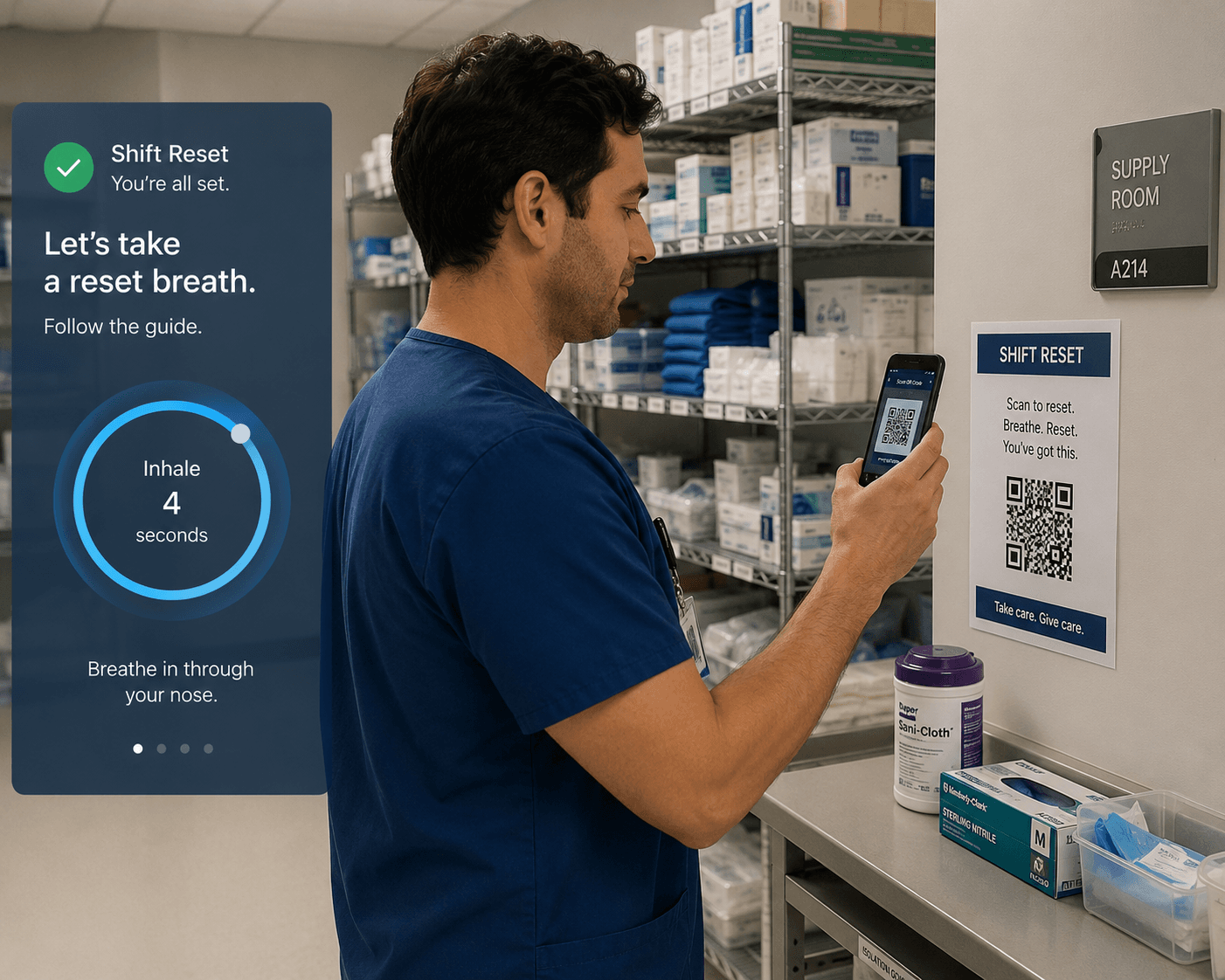
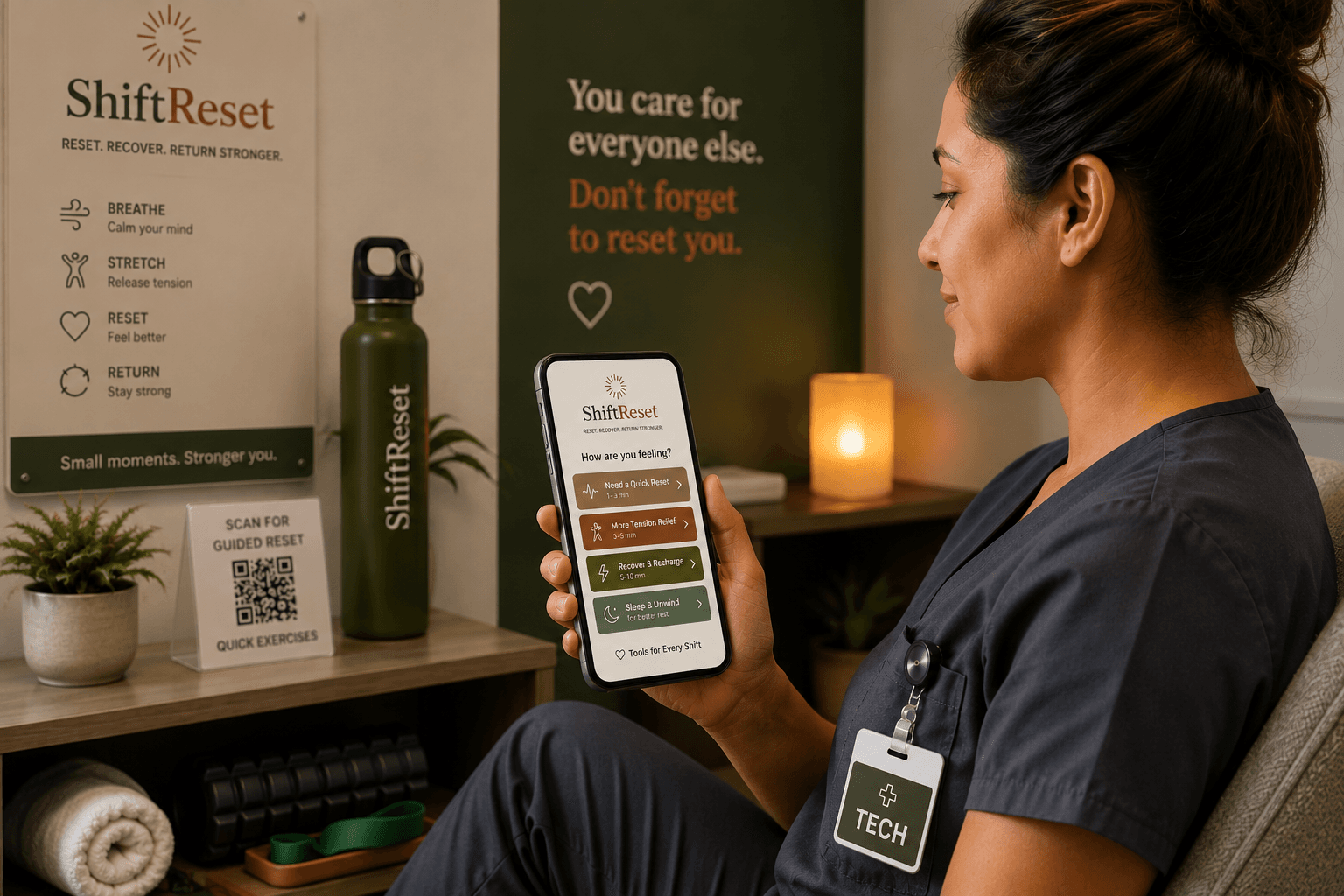
A recovery station on one unit. Real data from real shifts.
Zero procurement, no extra staff. We bring the recovery station, the tools, and the feedback data. You see if it works before scaling. ShiftReset uses a three-tier pilot model so healthcare teams can support staff recovery without jumping straight into a large purchase. Start with QR-code guided resets, add a simple physical recovery toolkit, and grow into a dedicated recovery pod or reset room when the need and usage are validated.
Research supporting ShiftReset includes:
ShiftReset is built on a foundation of clinical evidence and research. — Stanford Medicine research on structured breathing demonstrates rapid, measurable stress reduction. — Systematic reviews confirm that slow diaphragmatic breathing improves autonomic regulation. — Progressive Muscle Relaxation is proven to decrease both muscle tension and perceived stress. — Mindfulness interventions are shown to strengthen resilience in healthcare workers. — Occupational health research validates the effectiveness of brief recovery resets during demanding work.

Does a three-minute reset actually help?
We hear that question a lot. Here is what healthcare workers say after using the recovery station on their unit.
"Most wellness programs happen outside of work. What I need is something that helps me while I'm actually on the unit."
Jordan M.
Registered nurse, med-surg unit
I was skeptical about breathwork. But after a twelve-hour shift where I didn't sit down once, I tried the short breathing exercise by the QR code. My heart rate dropped noticeably. I used it again the next day.
David K.
Respiratory therapist, ICU
Our team was burning out fast. Shift Reset placed a recovery station on our floor. Within two weeks, staff were using it between codes. The feedback was simple: 'I can breathe again.' That is not nothing.
Dr. Teresa L.
Emergency department medical director
"By the time I get home, my back and shoulders are killing me. If I could get even five minutes during my shift to stretch and reset, I'd absolutely use it."
Simone M.
Emergency department RN
"I don't need an hour-long program. I need something I can do in two or three minutes between patients."
Tim C.
OR Tech
"Healthcare workers spend all day caring for everyone else. It's nice to see an idea focused on taking care of us."
Tina O.
Physical Therapist

See what your colleagues say
Nurse managers and unit directors who piloted ShiftReset stations share what happened on their floors.
We set up the recovery station in the break room. Within two weeks, nurses were using it between codes. The feedback was immediate - they felt calmer and less tense by mid-shift.
Jessica Tran
Nurse Manager, Medical-Surgical Unit
I was skeptical about a three-minute reset making a difference. Then I tried the breathwork sequence after a tough morning. My shoulders dropped an inch. I signed off on the pilot the same day.
Marcus Williams
Director of Nursing, Emergency Department
The QR code setup meant zero IT involvement. Staff scanned, reset, and went back to their patients. Utilization data showed 80% of the shift used it at least once.
Elena Rossi
Clinical Operations Lead, ICU
We were losing good staff to burnout. The recovery station gave them a real break without leaving the unit. Retention discussions shifted from exit interviews to reset time.
David Okonkwo
Chief Nursing Officer

Meet our founder
ShiftReset™ was created by Avelena-Rose Ortega, RN, BSN, MBA candidate, drawing on nearly two decades of healthcare experience. The ShiftReset system is continuously refined through interviews and collaboration with frontline clinicians, nurse leaders, and healthcare executives to ensure it addresses the real challenges of today's healthcare workforce.